What We Learned Deploying Smart Safety Tech to 100,000+ Construction Workers
After several years of scaling our Smart Site Safety System across some of the world's largest construction projects (covering multi-kilometer sites with tens of thousands of workers), we've learned what separates promising demos from systems that actually work.
Oct 30, 2025
Delivery
7 min
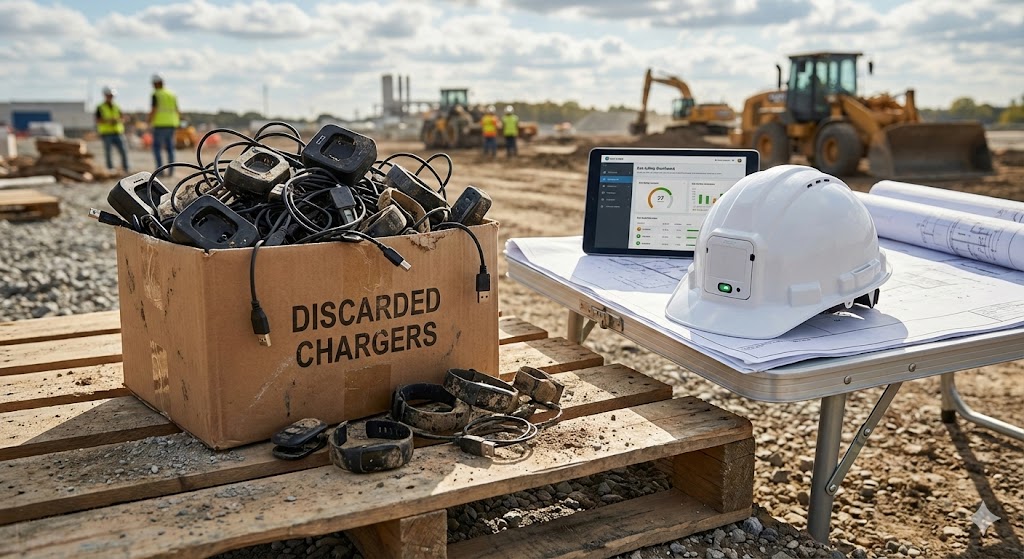
This isn't about pointing fingers at competitors. It's about sharing hard-won lessons, gained through a focus on actual customer usage rather than solely on sales, in the hope of preventing others from making similar errors.
The Uncomfortable Truth About Scale
Here's what nobody tells you: proof-of-concept deployments lie to you. A hundred workers on a controlled site will forgive reliability gaps and battery issues. Five thousand workers across five square kilometers will not.
We've watched this pattern repeat itself across the industry. What looks brilliant in a boardroom presentation often falls apart on an actual jobsite. The systems that work at scale are often boring. They're not trying to do everything. They're not packed with every sensor in the catalog. They do a few things exceptionally well: presence tracking, mustering, SOS, man-down alerts, observation management.
The companies that succeed at scale are usually the ones willing to say "no" to feature requests that would compromise reliability. We've learned to be almost religious about this.
That might sound like a decision that stifles innovation, but it's actually the opposite. It forces us to stay innovative about how we bring new technology to customers. We can't just bolt on the latest sensor or AI feature because it's trending. Instead, we have to look at every new technology advancement and figure out how to make it work reliably within the messy reality of a construction project. Not as a lab demo, but as something that still functions on day 200 when it's covered in dust and the site's expanded by two kilometers.
What Actually Works: Hard Lessons from the Field
The Battery Problem Everyone Underestimates
Early on, we saw sites deploy GPS-heavy helmet modules with solar panels. Sounds clever, right? In practice, those sites ended up with hundreds of charging stations, and someone's full-time job became managing a rotating fleet of dead batteries. When you're tracking 5,000 workers, charging devices every few days sim ply doesn't scale.
Battery management isn't a minor operational detail. It's a deal-breaker.
Our fix? We went obsessively low-power. Bluetooth Low Energy instead of continuous GPS. The result is devices that run 18+ months on a single battery. That means we're changing batteries once during a project phase, not every week. If your HSE team is managing battery logistics daily, something's fundamentally wrong with your design.
Why Wearables Keep Failing the "Real PPE" Test
There's a gap between how engineers design wearables and how construction workers actually dress for work. We've seen forehead sensors that couldn't read through the head coverings workers wear under their helmets. We've seen smartwatches that looked great until we realized there's no enforcement mechanism. You can make someone wear a helmet, but good luck mandating a watch.
The lesson? Any wearable has to fit seamlessly into existing PPE routines, or it won't get worn. Period.
We stopped thinking about "getting workers to adopt" the technology. Instead, we made it invisible. Everything integrates into the helmet's ratchet mechanism. No wires, no skin contact, nothing workers need to remember to charge or put on. If they're wearing their helmet (which they have to), they're in the system. Make adoption inevitable, not optional.
When Network Infrastructure Breaks Down
We've seen competitors blanket sites with dense LoRaWAN networks that still had coverage gaps. High-data scenarios (like real-time worker presence across a sprawling site) just overwhelmed these setups. Meanwhile, we watched operators staring at dashboards full of offline devices and empty maps. Eventually, they gave up and went back to CCTV cameras.
The shift for us was treating this like a mesh network problem, not a long-range radio problem. Bluetooth mesh with solar-powered gateways mounted on existing infrastructure, often the same poles as CCTV. The coverage became predictable, even inside steel structures. More importantly, it stayed intact as the site evolved.
Sites change constantly. Buildings go up. Steel structures interfere with signals. Dust covers everything. Your system needs to handle peak headcount during shift changes, work during sandstorms, and still be readable when someone's covered in mud at the end of a shift. Design for the worst case, not the average.
Operations Trump Features, Every Time
The fanciest sensor is worthless if your HSE team doesn't trust it. We now assign dedicated site engineers to every major deployment. Their job isn't to sell. It's to make the system work. Commissioning, drills, training, weekly reliability reviews. Boring stuff. Essential stuff.
Here's another thing we learned: the Project Control Center (PCC) is your customer. Not the C-suite. The actual operators in the PCC who need to know where everyone is during an emergency, who's responding to an SOS, and whether a muster is complete. If they're not using your dashboards as the source of truth, you've failed regardless of what the contract says.
If you're evaluating safety technology for your projects, our advice is simple: ask about battery management logistics. Ask about uptime SLAs. Ask if they have dedicated site engineers. Ask to talk to their PCC operators, not just their executives. The answers to those questions will tell you more than any demo or spec sheet ever could.
Where the Industry is Headed
The construction sites we're working on today would have been impossible to manage with technology from even five years ago. Real-time location awareness for thousands of workers. AI-powered safety observations that generate actionable insights instead of just boxes on video feeds. Integration between permits, weather data, and presence systems.
But here's the thing: all of that advanced capability means nothing without operational excellence as the foundation. Battery life. Network reliability. Security. Training. Support.
The future of construction safety tech isn't more sensors or fancier dashboards. It's systems that work reliably enough that safety teams actually trust them with people's lives. Systems that are still working on day 437 of a project when nobody's paying attention anymore.
That's the standard we're holding ourselves to, and it's taken us years of learning (often through failure) to get there. Because in construction, the technology that matters isn't the one with the most features. It's the one that's still running when it counts.
Comments